Cut Subscription Costs by Self-Hosting Your Automations With n8n
Per-task automation bills add up fast. Self-hosting n8n lets you own your workflows and drop the metered pricing - but only if the break-even math and your willingness to maintain a server actually add up. An honest guide.
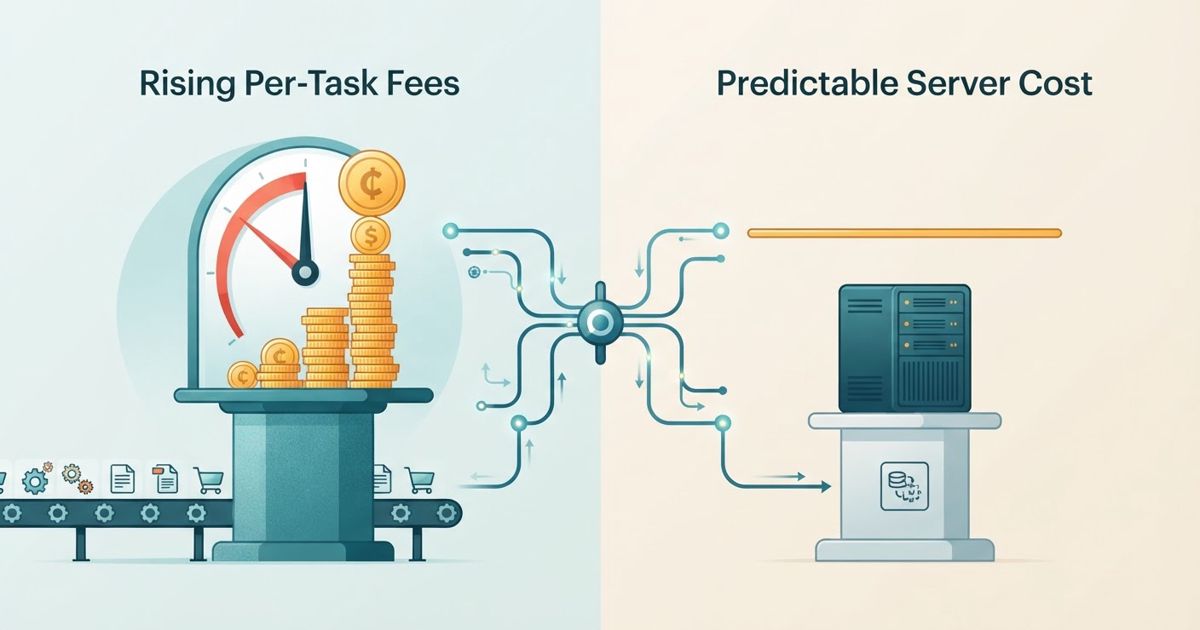
Table of contents
Automation subscriptions have a way of creeping up on you. You start with a free Zapier or Make plan, your workflows get useful, you cross a task limit, and suddenly you are on a paid tier that charges by the operation. Every extra step, every extra run, every "let me add one more thing" nudges the bill higher. For a busy small business that is a lot of value — but it can also be a slow leak on your monthly costs.
Self-hosting your automations with n8n is the main way people escape that per-task meter. Instead of paying for every operation a cloud platform runs on your behalf, you run the automation engine yourself and pay for the server, not the volume. This guide is about when that math works, when it doesn't, and what you are really trading.
What "self-hosting n8n" actually means
n8n is open-source (fair-code) automation software you can install on your own server with Docker or npm. It gives you the same node-based visual editor and hundreds of integrations as a hosted product, but it runs on infrastructure you control. Once it is up, you can build as many workflows as you like and run them as often as you like without a usage counter ticking in the background.
That single difference — no per-task metering — is the whole cost argument. On metered platforms your bill scales with how much you automate. On a self-hosted box, running 1,000 tasks a day costs the same as running 50: the price of the VPS.
The break-even math, honestly
Here is the part most "save money" pitches skip. Self-hosting is not free. You need a small VPS, which is a modest fixed monthly cost, and you need to spend some of your own time keeping it running — updates, the occasional restart, making sure backups exist. So the real comparison is not "free vs paid." It is:
Cost of a metered plan at your volume versus cost of a small VPS + your maintenance time.
If you are a light user who runs a handful of simple automations, a hosted plan — including n8n's own managed Cloud — is often cheaper in real terms, because your time is worth more than the few dollars you would save. The metered bill is small and you never think about servers.
If you are a heavier user — lots of workflows, high run counts, or steps that would each be billed as separate operations — the metered model is where costs balloon, and a flat-priced VPS quickly wins. This is the same logic behind why people move to lifetime deals instead of monthly subscriptions: past a certain usage, paying once beats paying forever.
The honest rule: self-hosting is a net win only if you will actually run it. A VPS you set up, half-configure, and abandon is worse than the subscription you were trying to cancel.
What you gain besides money
Cost is the headline, but it is not the only reason people self-host.
- You own your data. Your workflows and the data flowing through them live on your server, not a third party's. For anyone handling client information, that is a real consideration.
- No artificial limits. No task caps, no "this integration is on a higher tier," no being throttled at the worst possible moment.
- Full flexibility. You can add custom code nodes, connect to internal tools, and build things a locked-down SaaS plan would never let you.
If owning more of your stack appeals to you, self-hosting n8n fits naturally alongside running your own private AI on a VPS — same philosophy, same kind of box.
What you give up
Managed platforms are selling you convenience, and convenience is worth something.
- Maintenance is yours. Updates, security patches, and uptime are your responsibility. If the server goes down at 2 a.m., no support team is watching.
- Setup takes effort. Docker, a domain, HTTPS, backups — none of it is exotic, but it is an evening of work and a learning curve if you have never done it.
- You are the support desk. When a workflow breaks, you debug it.
The middle path most people miss
You do not have to choose between "pay per task forever" and "become a part-time sysadmin." n8n Cloud is the managed version of the same tool: you get the visual editor and integrations without touching a server, on predictable pricing rather than the runaway per-operation model that pushed you to look for alternatives in the first place. It is a genuinely good middle ground — especially if the goal is to escape a metered bill without taking on infrastructure.
A sensible way to decide:
- Light, occasional automations? Stay managed. Your time is the expensive resource.
- Growing volume, comfortable with a server? Self-host on a small VPS and enjoy the flat cost.
- Growing volume, but no appetite for maintenance? Move to n8n Cloud and keep the predictability without the sysadmin work.
The bottom line
The "stop paying per task, own your automations" pitch is real, but it is not automatic. Self-hosting n8n can meaningfully cut costs for heavier users and hand you ownership of your data — as long as you are honest that a VPS plus your own time is the true price. Do the simple break-even, be realistic about whether you will maintain it, and pick the option that saves you the resource you actually have least of.
If subscription creep is the broader problem you are fighting, it is worth pairing this with how to cut tech subscriptions without losing the tools you actually use and a look at whether a shared-subscription marketplace like Coosub fits the rest of your stack.